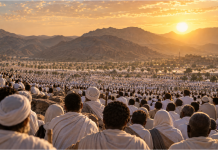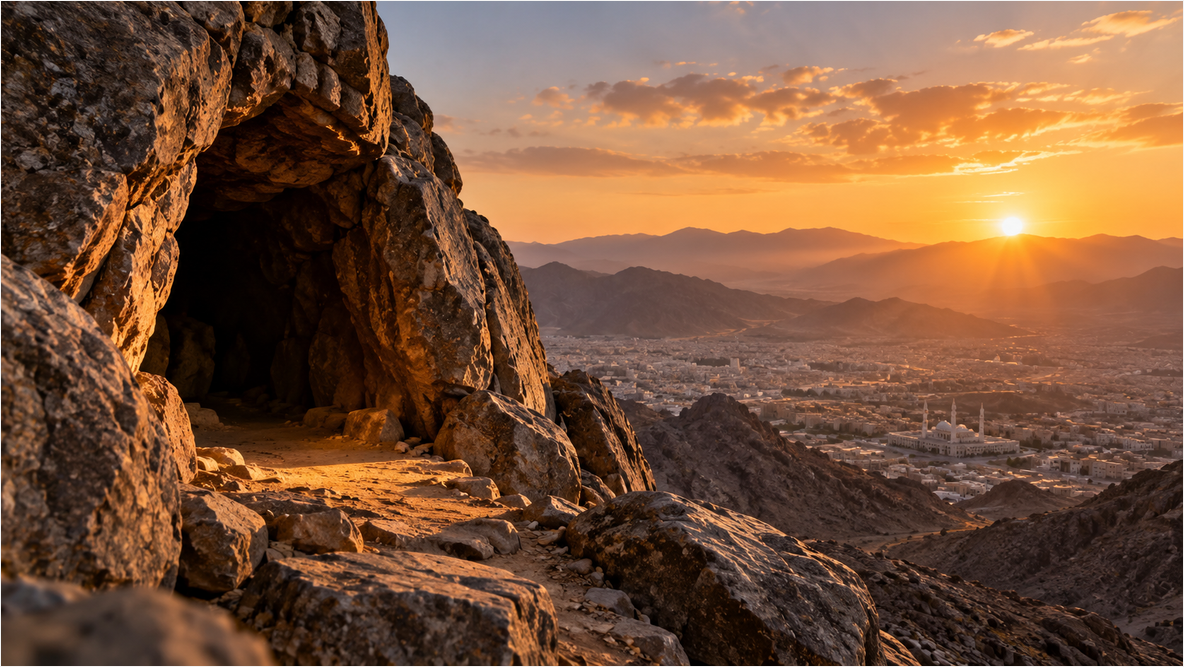
Before Muhammad ﷺ became the Messenger of Allah and before the first revelation came to him, there was a period of his life that is often mentioned only briefly. Yet it carries a profound meaning. It was a period of silence, solitude and searching. Muhammad ﷺ would retreat to the Cave of Hira, where he devoted himself to worship and contemplation. Sahih al-Bukhari describes how he grew fond of solitude and would return to the cave until revelation came to him. When we picture this moment, we see a man who did not yet know the future that awaited him. He did not know that through him the verses of the Qur’an would be revealed to humanity, that his life would transform the history of Arabia, or that his example would influence generations of people. He was not yet the leader of a community, a statesman, a teacher or the head of an ummah. He was a man seeking distance from the spiritual emptiness of the world around him and turning towards his Creator. And here we find the first deep lesson: sometimes great changes do not begin before the eyes of other people, but in the silence where a person remains alone with his heart and with his Lord. Modern life, however, often looks completely different. We are surrounded by sounds, screens, messages, social media and the constant opinions of others. Silence can feel like emptiness, and when nothing is happening around us for even a few minutes, we instinctively search for another distraction. Yet a person who never remains alone with his own thoughts may gradually lose the ability to hear his conscience. Hira reminds us that solitude does not necessarily mean loneliness, and silence does not necessarily mean emptiness. Sometimes silence is the space in which a person finally meets himself.
Then came the first revelation, bringing words that would mark the beginning of a new era: “Read in the Name of your Lord Who created.” (Qur’an 96:1). It is remarkable that the first word of revelation is connected with reading and knowledge. The human being is called to learn, to understand, and to recognise that his existence has a Creator. Here we may see another profound dimension: before Muhammad ﷺ was given the enormous responsibility of a public mission, there was a period of inner preparation. This can speak powerfully to our own lives. We often want change immediately. We want answers, success, certainty and a clear direction, but we do not want the period that may come before them. When nothing seems to be happening for a long time, we feel that we are standing still. Yet some of the most important things grow like the roots of a tree: unseen for a long time, but developing all the while. A person may pray and feel that nothing is changing. He may study, correct his mistakes and try to become a better Muslim without anyone around him noticing. He may even go through a period in which he feels alone and does not understand why his life has taken the shape it has. But not everything that is invisible is inactivity. Sometimes the most important preparation is taking place precisely then. Hira can therefore be understood as a symbol of those periods when a person cannot yet see the result, but Allah sees the entire process.
It is also important to understand that Muhammad’s ﷺ solitude in Hira was not an escape from responsibility. It was preparation for a responsibility far greater than anyone around him could have imagined. This distinction matters. Sometimes spiritual life is understood as withdrawing from the world and avoiding its problems. Yet the story of Muhammad ﷺ shows the opposite. He did not leave the cave in order to remain there. He emerged from it and returned to the world of people, carrying a mission that would bring immense responsibility, opposition, ridicule, loss and persecution. Silence was therefore not the destination. It was preparation. And this may be one of the deepest lessons for us. Every person needs their own form of Hira — a place or a moment in which they step away from the noise so that they can return stronger and more focused. It does not have to be an actual cave. It can be a few minutes after prayer, a moment without a phone, a solitary walk, or an evening when all the screens are turned off and we allow ourselves to think. The important thing is not the location but the condition of the heart. Can we remain without a constant stream of information? Can we listen to ourselves? Can we honestly ask whether the way we live is truly consistent with what we believe? In an age when attention has become one of the most valuable commodities and thousands of stimuli compete for our minds every day, the ability to remain in silence for a while can become almost a spiritual discipline.
The story of Hira also reminds us that a person does not need to know the whole story of his future. Muhammad ﷺ did not know what was about to come. He did not know how much hardship awaited him, how many people would accept his message and how many would reject it, or how immense the impact of his life would become. He knew only what was before him at that moment. Perhaps there is a great lesson in this for us as well. The future often frightens us precisely because we want to know the whole story in advance. We want to know what life will look like in a year or five years, whether our prayers will be answered, whether we will find our place, whether certain doors will open and whether others will remain closed forever. But faith does not teach us that we must know the entire plan. It teaches us to trust the One who knows it. Perhaps some periods of our lives are not signs that something has gone wrong, even when we feel that we have stopped moving forward. Perhaps we are simply being prepared. Perhaps a season of silence, uncertainty or solitude is creating the space for something we are not yet ready to receive. We do not know what Allah intends for our lives, just as Muhammad ﷺ could not have known, before the first revelation, the full extent of the mission that lay ahead of him. But we can work on making our hearts ready for the next step when it comes.
The Cave of Hira, therefore, is not merely the place where the first revelation began. It is a symbol of inner preparation, of searching for truth, and of the ability to step away from the noise of the world. Perhaps that is why its message is as relevant today as ever. We live in a time when we have access to more information than previous generations could ever have imagined, yet that does not necessarily mean that we possess more wisdom. We have countless ways of remaining connected to other people, yet that does not necessarily mean that we are closer to ourselves or to our Creator. We have more ways to occupy our minds, but perhaps fewer opportunities to think deeply. Hira teaches us that sometimes we need to step out of the noise, not in order to escape from life, but so that we can return to it with a clearer mind and a steadier heart. And perhaps this is one of the greatest lessons of the life of Muhammad ﷺ: not every period of silence is empty waiting. Some are preparation for something we cannot yet see.