
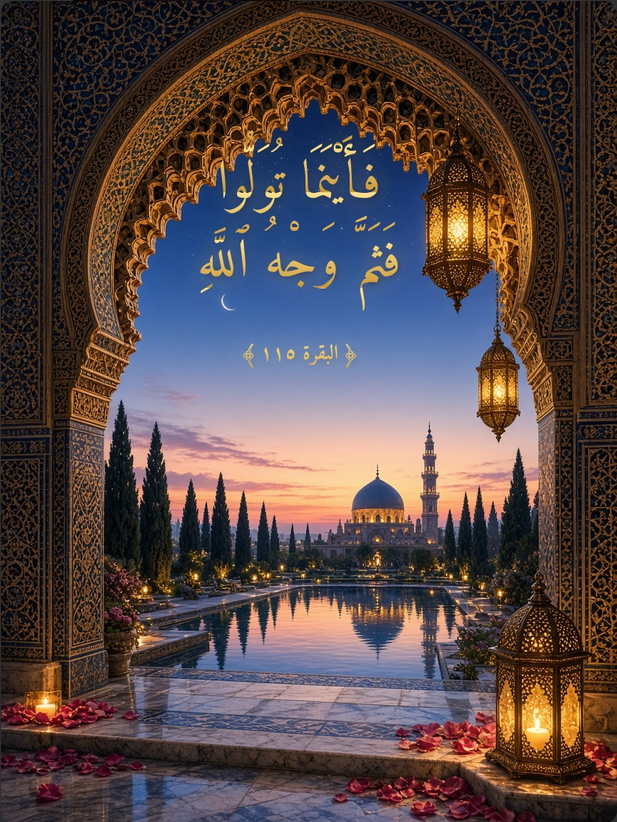
All day long we move from room to room: from home to work, from work to the shop, from prayer back to our worries. We rarely notice that the most important things happen not inside the rooms but on the thresholds between them, in the brief moment when one thing has ended and the next has not yet begun.
The Prophet taught us to sanctify every door
Islam pays more attention to these thresholds than we might first think. The Prophet Muhammad, peace and blessings be upon him, taught his companions what to say when leaving the house: “In the name of God, I rely on God, there is no might and no power except with God.” (Abu Dawud 5095, al-Tirmidhi 3426) Stepping over the threshold becomes a small act of surrender. We do not know what awaits us outside, but we do not go out alone.
Even more beautiful is the Prophet’s supplication on entering the mosque: “O God, open for me the gates of Your mercy.” On leaving, one says: “O God, I ask You of Your bounty.” (Muslim 713) The threshold of the mosque is a place where the heart is retuned. The rush stays outside, and the one who steps in is someone asking for open doors.
Between day and night
Time has its thresholds too, and the most striking of them is dusk, when day turns into night. The Quran says: “Indeed, in the creation of the heavens and the earth and the alternation of night and day are signs for those of understanding.” (3:190) The alternation of day and night is not just the backdrop of our lives but a sign to reflect upon. It is no coincidence that the morning and evening remembrances (adhkar) and the Fajr and Maghrib prayers fall precisely at these boundary moments.
Whoever pauses for a moment in the evening, before setting the day aside, can ask: what am I carrying out of today’s rooms? What should I leave at the door before I enter sleep?
All of life as a threshold
The Prophet once took Abdullah ibn Umar by the shoulder and said: “Be in this world as though you were a stranger or a traveller.” (al-Bukhari 6416) A traveller does not live on the road. He passes along it, knowing that his destination lies elsewhere. In this sense, our whole earthly life is one long threshold between where we came from and where we are returning.
The Quran also speaks of the threshold that follows death, the barzakh: “And behind them is a barrier until the Day they are resurrected.” (23:100) Even death, then, is not a wall but another passage.
On the threshold, there is no pretending
A threshold is a strange place. It belongs neither to the house nor to the street. Whoever stands on it has set down what they had and has not yet received what is coming. In that brief poverty nothing can be faked, and that is why a person is often closest to their own truth, and closest to their Lord, at exactly that moment.
And the Lord is near in every place, even in the gap between two steps. The Quran reminds us: “To God belong the East and the West. Wherever you turn, there is the Face of God. Indeed, God is All-Encompassing, All-Knowing.” (2:115) And elsewhere: “When My servants ask you about Me, I am indeed near. I answer the call of the caller when he calls upon Me.” (2:186)

