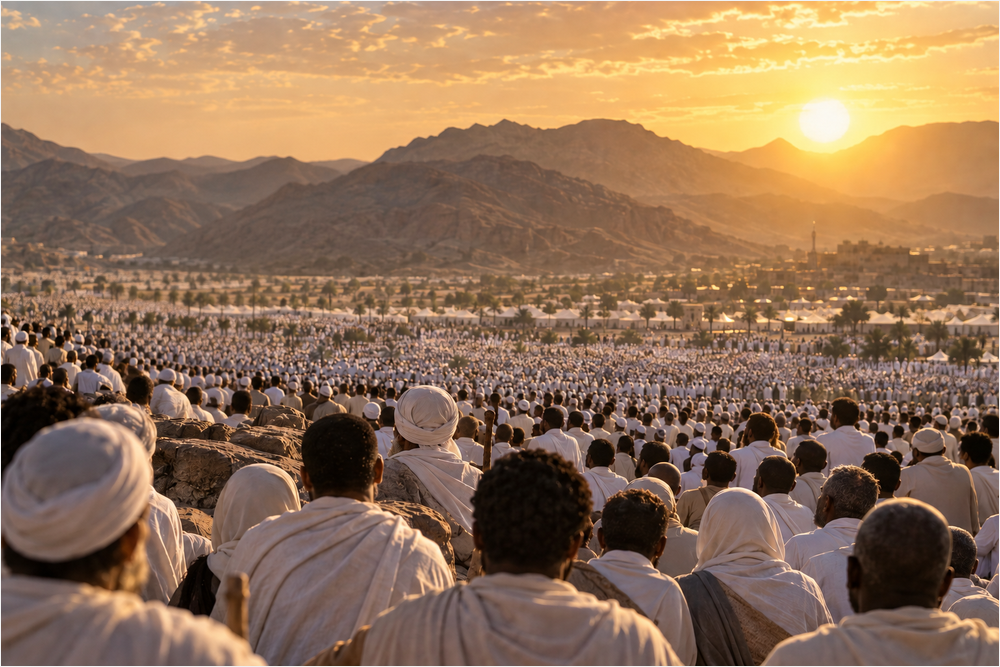
Imagine the sun-drenched valley of Arafat bathed in dazzling light. As far as the eye can see, a living sea of tens of thousands of people stretches out, all dressed in simple white garments. Here, there are no rulers or servants, no rich or poor. Everyone stands side by side as equals. The year is 632, and Prophet Muhammad (peace and blessings of Allah be upon him) is preparing to deliver his Farewell Sermon. The words spoken that day from Mount Ar-Rahmah became more than just a conclusion to his earthly mission—they became an eternal beacon for the entire Ummah.
In an era when the surrounding world lived in rigidly stratified castes and the desert was ruled by tribal lineage, the Prophet’s voice shattered centuries of prejudice with absolute clarity: “All mankind is from Adam and Eve. An Arab has no superiority over a non-Arab, nor does a non-Arab have any superiority over an Arab; a white has no superiority over a black, nor does a black have any superiority over a white—except by piety and good action.”
With this single statement, the foundation was laid for a spiritual and social revolution. Blood feuds, usury, and the shadows of ancient ignorance (Jahiliyyah) were swept away forever. The Prophet did not merely present a theory of equality; he instilled in believers the understanding that the only true measure of human worth lies in the state of one’s heart and the purity of one’s intentions.
With profound urgency, he also addressed the family and the rights of women in his sermon. He reminded those present that women are their partners and that treating them with kindness, respect, and justice is a sacred duty before the Creator. He called for the protection of honor, property, and human life with the same sanctity attached to the holy month of Dhul-Hijjah and the sacred city of Mecca.
Today, fourteen centuries later, we as Muslims often ask ourselves how to restore the original strength and purity of faith to our lives. The answer lies right on the plain of Arafat. The Farewell Sermon is not just a historical document sitting in libraries—it is a living call to action for each of us. It serves as a reminder to leave no room in our hearts for racism, arrogance, or injustice, and to act as a light of mercy in today’s divided world.
When the Prophet looked at his companions back then and asked, “When Allah asks you about me, what will you say?”, thousands of voices replied, “We bear witness that you have conveyed the message and fulfilled your duty.” The question for us today remains: What answer will we write with our own lives?