When Aisha, the Mother of the Believers, was asked about the character of the Messenger of Allah, she did not begin listing virtues. She did not say that he was kind, that he forgave, that he laughed with others. She answered with a single sentence that has since travelled through the Islamic world like a quiet light:
“His character was the Qur’an.”
In that sentence lies everything. And at the same time nothing that can be easily imitated. Because the Qur’an is not merely a book of commands. It is the way a person stands before God, before people, and before himself. And the Prophet lived this way even when he no longer had to.
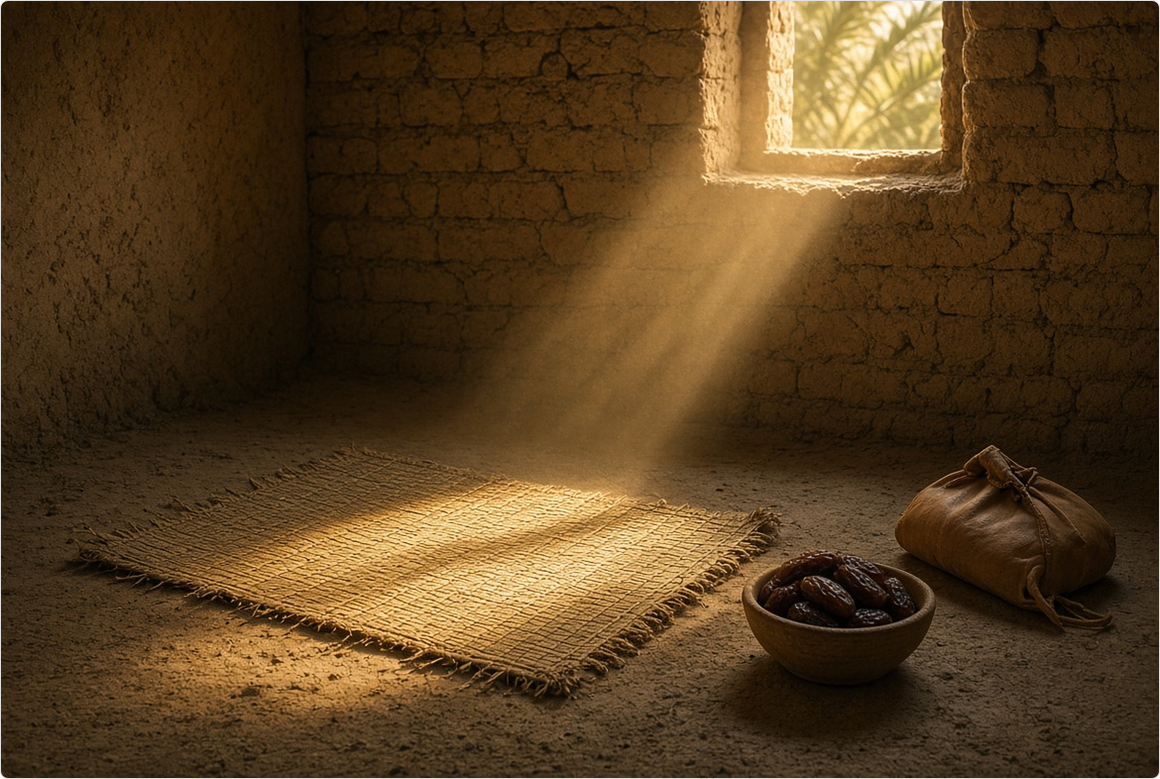
Toward the end of his life he ruled over a large part of Arabia. He could have had a house built for himself, he could have eaten whatever he wished, he could have surrounded himself with servants. Instead, it happened that for a whole month no fire was lit in his house. Aisha related that the family of Muhammad never ate wheat bread to satiety for two consecutive days until he died. Often only dates and water. Sometimes not even that.
Once Umar entered upon him. The Prophet was lying on a mat, and the mat had left marks on his side. Umar began to weep. When the Prophet asked why, Umar replied that the Persian and Byzantine kings lived in luxury, while he, the Messenger of Allah, lay like this. The Prophet looked at him and said something that cannot be translated without loss:
“Are you not content that for them is this world and for us the Hereafter?”
It was not a rebuke. It was a quiet reminder that there are two ways of being powerful. One takes from this world everything it can. The other takes from it only what is needed to live, and leaves the rest. The Prophet chose the second.
Aisha used to say that at home he was like any other man. He mended his own sandals, sewed his own clothes, and helped with the housework. When the time for prayer came, he went. It was not the image of an ascetic who withdraws from life. It was the image of a man who does not need anyone to serve him in order to know who he is.
And when he died, he left neither dinar nor dirham. Neither male slave nor female slave. Only a white mule that he used to ride, his weapons, and a piece of land that he bequeathed as charity for travellers. Amr ibn al-Harith related it simply, without pathos. As if to say: that is how he was.
The Prophet once said that this world was for him like the shade of a tree under which a rider stops for a moment to rest, then continues on his way. It is not contempt for the world. It is the awareness that the world is not the goal. It is only a place through which one passes. And whoever understands this need neither fear it nor bind himself to it.
In the Islamic tradition these reports are spoken of in different ways. Some see in them a perfect example for those who carry responsibility — so that wealth and power do not change their hearts. Others read in them an inner freedom: a person may have access to everything and yet choose little, because his heart already belongs elsewhere. Contemporary writers often add a third layer: in an age when a person’s worth is measured by what he owns and how he displays it, this modesty is a quiet yet radical answer.
It is not a call for everyone to sleep on a mat. The Prophet himself never said that poverty is a virtue in itself. He said only — through his life — that a person can stand at the summit and still remain light. That power need not mean accumulation. That dignity is not measured by how much one can afford, but by how much one is able to leave behind.
And perhaps that is why Aisha’s sentence is so quiet and so heavy. His character was the Qur’an. Not because he recited verses, but because he lived them even when no one was watching. Even on the mat. Even with dates and water. Even when he could have had everything.
That is a modesty that does not lose its strength. On the contrary — that is precisely why it has it.