During the Ottoman Empire, the celebrations marking the end of Ramadan reached unprecedented visual and social grandeur. What was originally a purely religious ritual evolved into an event of society-wide significance, connecting the common people with the Sultan himself and leaving behind traditions that largely persist in the Middle East and the Balkans today.
The Sugar Feast, or the Feast of Gratitude? In Turkey and the territories of the former Ottoman Empire, Eid al-Fitr is often referred to as Şeker Bayramı (Sugar Feast). However, historians point to an interesting linguistic mix-up that likely preceded this name. Originally, the holiday was called Şükür Bayramı (Feast of Gratitude). In Ottoman Turkish, which used the Arabic script at the time, the words for “sugar” and “gratitude” were spelled exactly the same. Given the enormous amounts of sweets—from traditional baklava to Turkish delight (lokum)—consumed during the celebrations, the name associated with sugar eventually took root in popular speech.
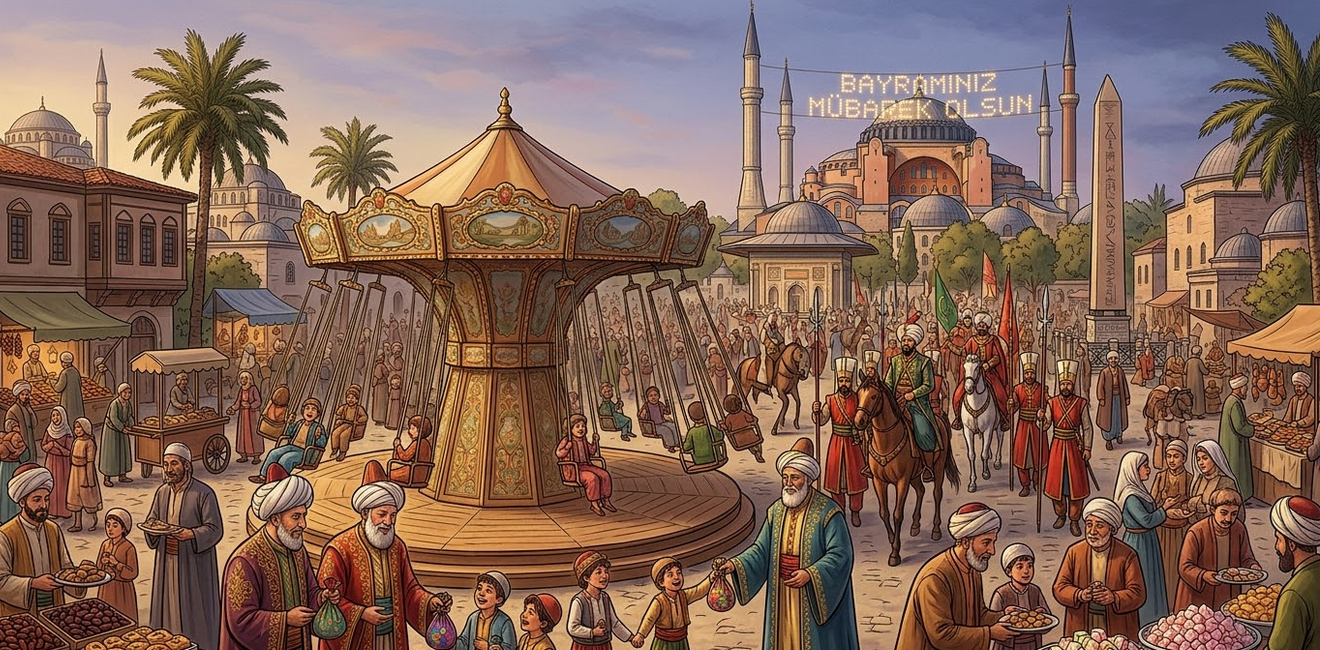
Court Pomp and the Sultan’s Ceremonies (Muayede Alayı) Official celebrations began at the Sultan’s court in the Topkapi Palace in Istanbul. The palace protocol, known as Muayede Alayı (Greeting Ceremony), was strictly regulated and designed to showcase the grandeur and power of the empire. As early as the eve of the holiday (known as Arife), prayers were held to the accompaniment of the traditional Janissary military band (Mehter). On the day of the festival itself, the Sultan wore a special, richly decorated ceremonial kaftan and sat on his throne to receive congratulations from the Grand Vizier, top officials, and clerics. The entire ceremony was accompanied by festive cannon salvos, announcing the start of the celebrations to the whole city.
The Illuminated City and Street Festivities Istanbul and other major cities transformed beyond recognition during the holidays. While nighttime street life was relatively quiet for the rest of the year, at the end of Ramadan, the streets lit up. A specific Ottoman art form was mahya—the stringing of ropes between the minarets of mosques, upon which hundreds of oil lamps were hung. In the dark, these formed glowing inscriptions or massive images of crescents.
People in their finest clothes strolled through illuminated streets and gardens. Giant festive swings and wooden Ferris wheels (called bayram salıncakları) were erected in the squares. These rides were often operated by the elite soldiers themselves—the Janissaries—as a way to earn extra money during the holidays. After dark, families gathered around the traditional shadow puppet theater, where the characters of Karagöz and Hacivat offered humorous and satirical commentary on contemporary society, entertaining adults and children alike.
Erasing Debts and Quiet Solidarity A truly unique element of the Ottoman celebrations was their deep, thoughtful approach to social solidarity. One of the most beautiful customs involved the Zimem defteri (Debt Ledger). During the holidays, wealthy Ottomans would anonymously visit local shops and markets in poorer neighborhoods. They would ask the merchant for the debt book and randomly pay off selected debts—or even the entire book—on behalf of the local residents. None of the shoppers knew who had paid their debt, and the benefactor did not know exactly whom they had helped. In this way, the dignity of the poor was preserved.
Another tradition, eagerly anticipated especially by children, was the giving of gifts. Hosts in affluent homes generously distributed not only sweets but also something called diş kirası (literally “tooth rent”). These were small silk pouches containing silver or gold coins, given to guests and children as a token of appreciation for honoring the host’s table and “wearing out their teeth” on the host’s food.